A cooking method is easier to appreciate when you connect it with the food on the plate. The background below explains the subject in more detail; for a complete method and ingredient quantities, explore the recipe collection.
Overview
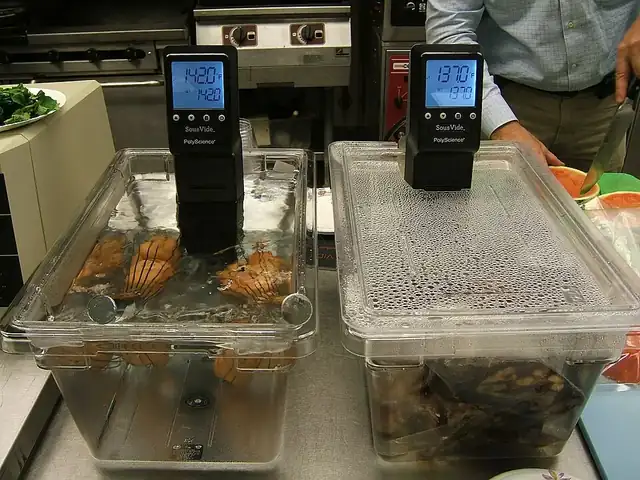
Sous vide (French for 'under vacuum'), also known as low-temperature, long-time (LTLT) cooking, is a method of cooking, invented by the French chef Georges Pralus in 1974, in which food is placed in a plastic pouch or a glass jar and cooked in a water bath for longer than usual cooking times (usually one to seven hours, and more than three days in some cases) at a precisely regulated temperature.
The temperature is much lower than usually used for cooking, typically around 55 to 60 C for red meat, 66 to 71 C for poultry, and higher for vegetables. The intent is to cook the item evenly, ensuring that the inside is properly cooked without overcooking the outside, and to retain moisture.
Essential features
Sealing the food in sturdy plastic bags retains juices and aroma that otherwise would be lost in the process. Placing the packaged food in a water bath, with the temperature set at the desired final cooking temperature of the food, prevents overcooking, because the food cannot get hotter than the bath it is in, as in bain-marie.
As a result of precise temperature control of the bath and the fact that the bath temperature is the same as the target cooking temperature, very precise control of cooking can be achieved. Additionally, temperature, and thus cooking, can be very even throughout the food in sous vide cooking, even with irregularly shaped and very thick items, given enough time.
By contrast, in conventional high-heat cooking, such as oven roasting or grilling, the food is exposed to heat levels that are much higher than the desired internal cooking temperature, and it must be removed from the high heat prior to reaching the desired cooking temperature. If the food is removed from the heat too late, it becomes overcooked, and if it is removed too early, it is undercooked.
Temperature
The degree of accuracy and constancy of cooking temperature required varies with the food cooked. In some cases, it is not critical. A 15 mm piece of fish will cook in 17 to 18 minutes at any temperature from 44 °C to 61 °C. Such food can be cooked in a switched-off slow cooker filled with hot water and a thermometer.
For an egg, though, which has proteins that denature at different temperatures, maintaining precise, constant temperature is more critical. Confit egg yolks are usually cooked at 63 °C, which is hot enough to cook the white without setting the yolk. The temperature of the bath is set to 64 °C.
Regular cooking times are determined by when the center of the cooked item reaches a few degrees below the targeted temperature. Then heating should be stopped immediately. While the food rests, residual heat will continue to cook it for a while. If the heating continues, the food will be overcooked. The time taken for the center of food to reach the target temperature depends on the initial temperature, the thickness and shape of the food, and the temperature of the bath.
Limitations
One limitation of sous vide cooking is that browning (Maillard reactions) happens at temperatures above the boiling point of water. The flavors and "crust" texture developed by browning are generally seen as very desirable in the cooking of certain types of meat, such as a steak. The flavors and texture produced by browning cannot be obtained with only the sous vide technique. In many cases, chefs will brown meats and other foods before or after sous vide cooking, using techniques such as torching or searing on an extremely hot pan. This secondary browning is done briefly, and sometimes at higher heat than usually used, so as to affect only the surface of the food and to avoid overcooking the interior.
Similarly, the skin of fish can be cooked at high temperatures after the sous vide to make the skin crisp.
Safety
Food safety is a function of both time and temperature; a temperature usually considered insufficient to render food safe may be perfectly safe if maintained for long enough. Some sous vide fish recipes, for example, are cooked below 55 C. People with compromised immunity should never eat food that has not been properly pasteurized. Women eating unpasteurized food while pregnant expose themselves and their fetuses to risk and thus may choose to avoid unpasteurized recipes.
Clostridium botulinum bacteria can grow in food in the absence of oxygen and produce the deadly botulinum toxin, so sous vide cooking must be performed under carefully controlled conditions to avoid botulism poisoning. Generally speaking, food that is heated and served within four hours is considered safe, but meat that is cooked for longer to tenderize must reach a temperature of at least 55 C within four hours and then be kept there for sufficient time, to pasteurize the meat.
Pasteurization kills the botulism bacteria, but the possibility of hardy botulism spores surviving and reactivating once cool remains a concern as with many preserved foods, however processed. For that reason, Baldwin's treatise specifies precise chilling requirements for cook–chill, so that the botulism spores do not have the opportunity to grow or propagate. Pasteurized food can then be stored for up to two weeks around 3 C sealed within the vacuum pack. Exposure to air also inactivates spore growth.
Endocrine disruptors
Most plastics release estrogenic chemicals that act as endocrine disruptors when heated. The degree of danger posed is controversial.
Also, some evidence shows that heterocyclic aromatic amines and bisphenol-A migrate from the plastic container into the food in sous vide cooking.
Uses
The sous vide method is used in many high-end gourmet restaurants by chefs such as Heston Blumenthal, Paul Bocuse, Michael Carlson, Thomas Keller, Grant Achatz, Ferran Adrià, Joël Robuchon, Philippe Rochat, Alessandro Stratta, Charlie Trotter, Michael Mina and Joan Roca. Amtrak also uses this method for meals served on their trains, including the Acela.
Sous vide has become common on cooking TV shows such as Iron Chef America and Top Chef, and in restaurants such as Panera Bread. It has also been used to quickly produce significant quantities of meals for hurricane evacuees. Nonprofessional cooks are also beginning to use sous vide cooking.
More to savor
Toast
Boeuf Bourguignon
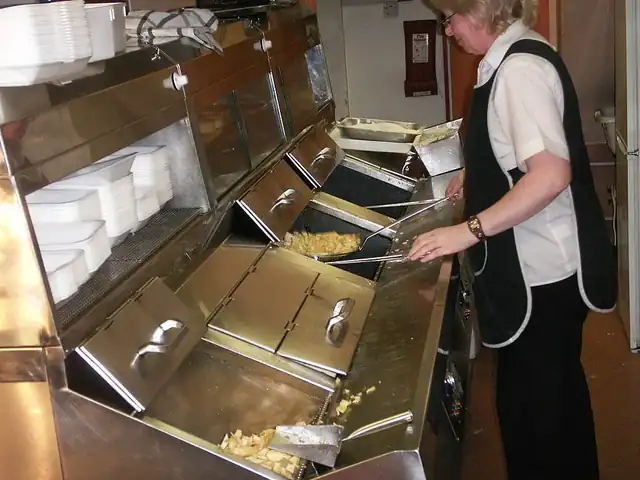
Deep Frying: The Cooking Method Behind a Golden Crunch