The dish is a starting point for exploring a wider food story. The guide below looks more closely at its background and different forms. When you want to cook, visit the recipe collection for ingredient quantities and step-by-step methods.
Overview
Spaghetti ( 'little strings' plural diminutive of spago 'string'; similarly spaghetto is a single strand) is a long, thin, solid, cylindrical pasta. It serves as a staple food of Italian cuisine and is made of milled wheat and water (sometimes enriched with vitamins and minerals), with the standard Italian version using durum-wheat semolina. The pasta is usually white because refined flour is used, but whole wheat flour may be added. Spaghettoni is a thicker form of spaghetti, while spaghettini is a thinner form. Capellini is a very thin spaghetti, while vermicelli is intermediate.
Originally, spaghetti was notably long, but shorter lengths gained popularity during the second half of the 20th century. Today, it is most commonly available in lengths of 25 - 30 cm. Various pasta dishes are based on it, and it is frequently served with tomato sauce, meat or vegetables.
Early
Spaghetti originated from an ancient, thin, and generally unleavened Middle Eastern bread, known as lakhsha in the Persian Sasanian Empire. Bakers flattened the dough by hand or with a rolling pin, and occasionally dried for preservation. Under the Sasanian Empire, it took on the name rishta when cut into strips or strings before drying a term possibly derived from the Iranian word risnatu, for which records of use exist as far back as the 2nd millenniumBC.
While pasta-drying traditions developed in Persia, pasta was introduced from the Middle East was also consumed in ancient in Roman and Greek societies. In Greece and Rome, the dough was frequently dried into long, stretched shapes. In the 7th century, Arabs conquered Persia, and thereafter spread the dried pasta custom throughout the lands they occupied, which included Sicily from the 9th century. There, the dried pasta practice became associated with the European traditions of making fresh pasta, and the name itriyya entered the language, meaning "long-form dried pasta". The very first recorded appearance of this new type of thin, dried pasta occurred in Trabia, near Palermo, as documented by the geographer Al-Idrisi.
Arrival in the Italian peninsula
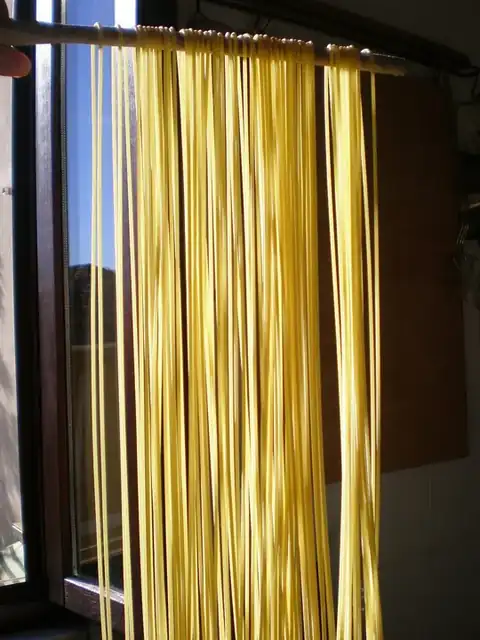
By the mid-12th century, records exist of several farms in Sicily producing itriyya at scale for local and export markets. Over the following centuries, this pasta appeared in Italian cookbooks, albeit infrequently. A precise description of the manufacture of "Sicilian macaroni" is given by Martino da Como in the late-15th century: a ball of dough, stretched thin, cut with a wire as "thin as spagho (string)", dried under the sun. The duration of this drying process varied with weather and humidity, but twelve days in the summer was typical. In another recipe for a Genoese pasta, Martino employs spagho for the first time in a culinary context when he says pasta ought to be cut "as thin as a spagho".
Several tools were employed for this cutting process, including chitarra in areas of southern Italy, which consisted of a wooden frame strung with wires, lowered onto the dough.
Later
In the 17th century, the region associated with pasta expanded from Sicily to Naples. Initially, Sicilians were depicted as 'macaroni eaters' and Neapolitans as 'leaf eaters' due to their vegetable-heavy diet; later, Neapolitans were also called 'macaroni eaters'. Around 1630, Naples under Spanish rule was experiencing famines with a reduced supply of meat and vegetables due to poor governance. As technology permitting industrial mixing and extrusion dramatically reduced prices of output, pasta became a staple food, no longer the domain of the elite. It is in this century that short cook times and firmer pasta textures emerged, although at first only for fresh pasta; it took until the mid-19th century in Naples for records of cooks taking a short cook time and firm texture for granted.
Production
Spaghetti is made from ground grain (flour) and water. Whole wheat and multigrain spaghetti are also sold. Most spaghetti is produced in factories using auger extruders. As the ingredients are mixed and kneaded, attention is paid to prevent air bubbles and ensure a homogenous mix. The forming dies are water-cooled to prevent overheating and spoiling the pasta. While drying the spaghetti, care is taken to prevent strands from sticking together and to leave sufficient moisture to avoid a product that is too brittle. Packaging for protection and display has moved from paper wrapping to plastic bags and boxes.
In Naples, spaghetti is thinner than it is in the United States. Spaghettoni is a thicker spaghetti, and spaghettini is a thinner spaghetti, although it is thicker than the pasta of Naples.
Preparation
Fresh or dried spaghetti is cooked in a large pot of salted, boiling water and then drained in a colander (Italian: scolapasta). Utensils used in its preparation include the spaghetti scoop and spaghetti tongs.
In Italy, spaghetti is generally cooked al dente , meaning it is fully cooked but still firm to the bite; however, it may also be cooked to a softer consistency. Spaghettoni takes more time to cook than regular spaghetti, whereas spaghettini takes less time. In southern Italy, spaghetti is sometimes placed in a dishcloth and broken into pieces to be served with vegetables, legumes or in a broth. This practice originated at a time when the region was very poor, and broken pieces of spaghetti were sold at a discount to prevent waste. Offcuts are still sold in parts of Italy, both alone and as part of pasta mista (an assortment of pasta shapes). Some factories donate their broken pieces to hospitals and nursing homes.
Serving
An emblem of Italian cuisine, spaghetti is frequently served with tomato sauce, which may contain various herbs (especially oregano and basil), olive oil, meat or vegetables. Other spaghetti preparations include amatriciana or carbonara. Grated hard cheeses, such as pecorino romano, Parmesan, and Grana Padano, are often sprinkled on top.
In the Philippines, a popular variant is the Filipino spaghetti, which is distinctively sweet with the tomato sauce sweetened with banana ketchup or sugar. It typically uses a large amount of giniling (ground meat), sliced hot dogs, and cheese. The dish dates back to the period between the 1940s and the 1960s. During the American Commonwealth Period, a shortage of tomato supplies in World War II forced the development of the banana ketchup. Spaghetti was introduced by the Americans and was changed to suit the local Filipino predilection for sweet dishes.
More to savor
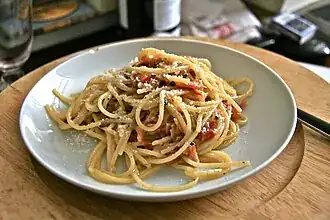
Spaghetti alla Carbonara
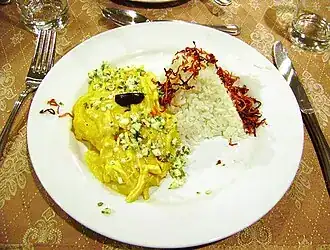
Ají de Gallina (Peruvian Chili Chicken)

Cake: A Slice of Celebration, a World of Possibilities