This longer reference provides the background behind the topic. Read it alongside the recipe collection when you want to connect an ingredient or food idea with a dish to prepare.
In this story
OverviewDescriptionAccepted species by continentFormerly placed hereIn foodDye and tanning agentTraditional medicinal useOverview
Sumac or sumach —not to be confused with poison sumac—is any of the roughly 35 species of flowering plants in the genus Rhus (and related genera) of the cashew and mango tree family, Anacardiaceae. However, it is Rhus coriaria that is most commonly used for culinary purposes. Sumac is prized as a spice—especially in Middle Eastern cuisine—and used as a dye and holistic remedy. The plants grow in subtropical and temperate regions, on nearly every continent except Antarctica and South America.
It holds cultural significance as a symbolic item on the Haft-sin table during Nowruz, the Persian New Year.
Description
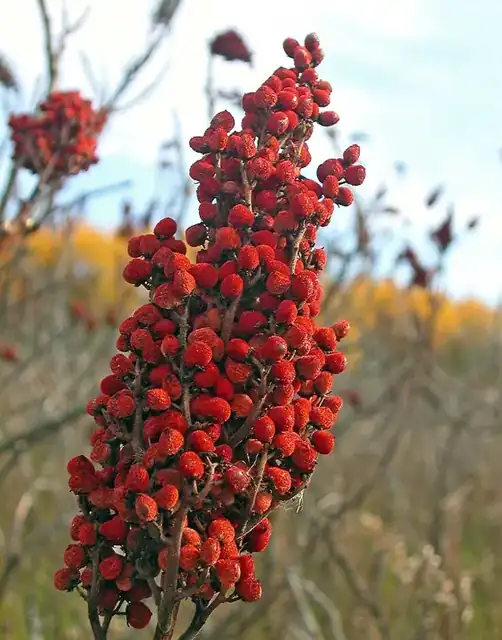
Sumacs are dioecious shrubs and small trees that can reach a height of 1 to(-). The leaves of its type species are pinnately compound, though some species have trifoliate or simple leaves. The flowers are in dense panicles or spikes 5 - 30 cm long, each flower very small, greenish, creamy white or red, with five petals. The fruits are reddish, thin-fleshed drupes covered in varying levels of hairs at maturity and form dense clusters at branch tips, sometimes called sumac bobs.
Sumacs propagate both by seed (spread by birds and other animals through their droppings), and by new shoots from rhizomes, forming large clonal colonies.
Accepted species by continent
As of November 2024, Plants of the World Online accepts 54 species.
Asia, North Africa and southern Europe
Rhus amherstensis W.W.Sm.
Rhus chinensis Mill. – Chinese sumac
Rhus coriaria L. – Sicilian sumac, Tanner's sumac
Rhus dhuna Buch.-Ham. ex Hook.f.
Rhus potaninii Maxim. – Potanin's lacquer tree or Chinese varnish tree
Rhus punjabensis J.L.Stewart ex Brandis
Rhus taishanensis S.B.Liang
Rhus teniana Hand.-Mazz.
Rhus wilsonii Hemsl.
Australia, Pacific
Rhus caudata Lauterb.
Rhus lamprocarpa Merr. & L.M.Perry
Rhus lenticellosa Lauterb.
Rhus linguata Slis
Rhus sandwicensis A.Gray – neneleau or Hawaiian sumac (Hawaii)
Rhus taitensis Guill. (Northeast Australia, Malesia, Micronesia, French Polynesia)
North America
Rhus allophyloides Standl.
Rhus andrieuxii Engl.
Rhus aromatica Aiton – fragrant sumac
Rhus arsenei F.A.Barkley
Rhus × ashei (Small) Greene (R. glabra × R. michauxii)
Rhus bahamensis G.Don
Rhus barclayi (Hemsl.) Standl.
Rhus chondroloma Standl.
Rhus choriophylla Wooton & Standl.
Rhus ciliolata Turcz.
Rhus copallinum L. – winged or shining sumac
Rhus duckerae F.A.Barkley
Rhus galeottii Standl.
Rhus glabra L. – smooth sumac
Rhus integrifolia (Nutt.) Benth. & Hook.f. ex W.H.Brewer & S.Watson – lemonade sumac
Rhus jaliscana Standl.
Rhus kearneyi F.A.Barkley – Kearney sumac
Rhus lanceolata (A.Gray) Britton – prairie sumac
Rhus lentii Kellogg
Rhus michauxii Sarg. – Michaux's sumac
Formerly placed here
Searsia mysorensis (G.Don) Moffett (as Rhus mysorensis G.Don) – Mysore sumac
In food
The dried fruits of some species are ground to produce a tangy, crimson spice popular in many countries. Fruits are also used to make a traditional "pink lemonade" beverage by steeping them in water, straining to remove the hairs that may irritate the mouth or throat, sometimes adding sweeteners such as honey or sugar. Sumac's tart flavor comes from high amounts of malic acid.
The fruits (drupes) of Rhus coriaria are ground into a reddish-purple powder used as a spice in many different cuisines to add a tart, lemony taste to salads or meat. In Middle Eastern Cuisine, it is used as a garnish on meze dishes such as hummus and tashi; it is also commonly added to falafel. Sumac is one of the main ingredients of Kubah Sumakieh in Aleppo of Syria, is added to salads in the Levant, and is one of the main ingredients in the Palestinian dish musakhan. In Afghan, Armenian, Iraqi, Iranian and Mizrahi Jewish cuisines, sumac is added to rice and grilled meats. In Armenian, Azerbaijani, Central Asian, Syrian, Iraqi, Jordanian, Palestinian, Israeli, Lebanese, Turkish and Kurdish cuisines, it is added to salads and lahmajoun.
Sumac from R. coriaria is used in the Levantine spice mixture za'atar.
In medieval Europe, primarily from the thirteenth to fifteenth centuries, sumac appeared in cookbooks frequently used by the affluent. One dish in particular called sumāqiyya, a stew made from sumac, was frequently rendered as "somacchia" by Europeans.
In North America, the smooth sumac (R. glabra), three-leaf sumac (R. trilobata), and staghorn sumac (R. typhina) are sometimes used to make a beverage termed "sumac-ade", "Indian lemonade", or "rhus juice". This drink is made by soaking the drupes in cool water, rubbing them to extract the essence, straining the liquid through a cotton cloth, and sweetening it. Native Americans also use the leaves and drupes of these sumacs combined with tobacco in traditional smoking mixtures.
Dye and tanning agent
The leaves and bark of most sumac species contain high levels of tannins and have been used in the manufacturing of leather by many cultures around the world. The Hebrew name og ha-bursaka'im means "tanner's sumac", as does the Latin name of R. coriaria. The leaves of certain sumacs yield tannin (mostly pyrogallol-type), a substance used in vegetable tanning. Notable sources include the leaves of R. coriaria, Chinese gall on R. chinensis, and wood and roots of R. pentaphylla. Leather tanned with sumac is flexible, light in weight, and light in color. One type of leather made with sumac tannins is morocco leather.
The dyeing property of sumac needed to be considered when it was shipped as a fine floury substance in sacks as a light cargo accompanying heavy cargoes such as marble. Sumac was especially dangerous to marble: "When sumac dust settles on white marble, the result is not immediately apparent, but if it once becomes wet, or even damp, it becomes a powerful purple dye, which penetrates the marble to an extraordinary depth."
Ibn Badis describes a formula for making red ink out of leeched sumac mixed with gum.
Sumac-dye was used for only the outerwear of the Emperor of Japan, thus being one of the forbidden colors.
Traditional medicinal use
Sumac was used as a treatment for several different ailments in medieval medicine, primarily in West, Central and South Asian countries (where sumac was more readily available than in Europe). An 11th-century shipwreck off the coast of Rhodes, excavated by archeologists in the 1970s, contained commercial quantities of sumac drupes. These could have been intended for use as medicine, as a culinary spice, or as a dye. A clinical study showed that dietary sumac decreases the blood pressure in patients with hypertension and can be used as adjunctive treatment.
More to savor

Chicken Vindaloo
Puff Pastry with Nuts and Whipped Cream (Om Ali)
Cinnamon in the Kitchen: Exploring an Everyday Ingredient