The dish is a starting point for exploring a wider food story. The guide below looks more closely at its background and different forms. When you want to cook, visit the recipe collection for ingredient quantities and step-by-step methods.
In this story
OverviewProductionDry matter losses and yieldDetermining qualityPreparationTypesCooking methods and recipesOverview
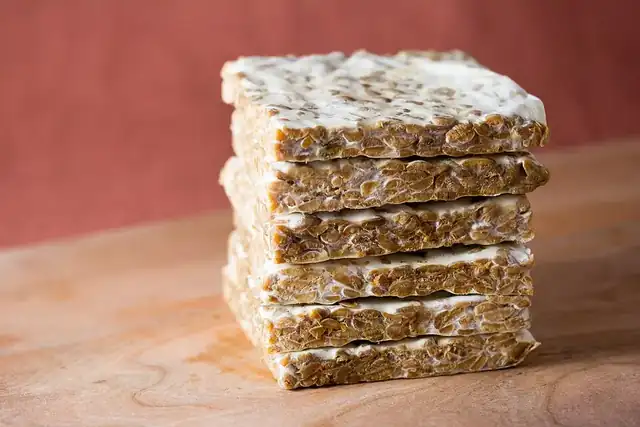
Tempeh or tempe (ꦠꦺꦩ꧀ꦥꦺ) is a traditional Indonesian food made from fermented soybeans. It is made by a natural culturing and controlled fermentation process that binds soybeans into a cake form. A fungus, Rhizopus oligosporus or Rhizopus oryzae, is used in the fermentation process and is also known as tempeh starter.
It is native of the island of Java, where it is a staple source of protein. Like tofu, tempeh is made from soybeans, but it is a whole-soybean product with different nutritional characteristics and textural qualities. Tempeh's fermentation process and its retention of the whole bean give it a higher content of protein, dietary fiber, and vitamins. It has a firm texture and an earthy flavor, which becomes more pronounced as it ages.
Production
Tempeh begins with whole soybeans, which are softened by soaking, dehulled, then partly cooked. Specialty tempeh may be made from other types of beans, wheat, or may include a mixture of beans and whole grains. Adding vinegar during soybeans soaking process had also been reported in tempeh industries and it had been found to influence the sensory nature of the final product.
The principal step in making tempeh is the fermentation of soybeans which undergo inoculation with Rhizopus spp. molds, a type of filamentous fungus most widely used for the production of tempeh. A fermentation starter containing the spores of fungus Rhizopus oligosporus or Rhizopus oryzae is mixed in. The beans are spread into a thin layer and are allowed to ferment for 24 to 36 hours at a temperature around 30°C (86°F). The soybeans have to cool down to allow spore germination and abundant growth of mycelium. Later, the temperature of the beans will naturally rise and rapid mold growth happens for around 4 hours. As mold growth declines, the soybeans should be bound into a solid mass by the mycelium. In good tempeh, the beans are knitted together by a mat of white mycelium.
Dry matter losses and yield
During the processing of soybeans to make tempeh there are inevitable losses of material due to the removal of the hulls and the leaching of soluble compounds during the soaking, washing and cooking stages. Hulls constitute about 8% of the dry beans and losses due to the leaching of soluble compounds equate to 12 - 17% of the dry beans. The oligosaccharides, stachyose, raffinose and sucrose, can constitute up to 50% of the soluble materials lost. During the fermentation there is some further loss of material due to respiration by the mold and the oxidation of compounds to carbon dioxide and water. Reported losses of dry matter during the fermentation range from 2.1 to 10%. Hence, the overall yield of tempeh is in the range of 72-78 g tempeh per 100 g soybeans on a dry matter basis.
In practical terms, this means that 100 g dry soybeans (7-9% moisture content) will yield about 170 to 210 g fresh tempeh (61-64% moisture content).
Determining quality
Once tempeh is produced, it is divided into three categories based on its quality: good, unfinished, and inedible. Good tempeh includes beans that are bound into a firm, compact cake by a dense, uniform, white mycelium, which should permeate the entire cake; the beans should be barely visible. The odor of good tempeh should be pleasant, clean, subtly sweet or resemble the aroma of mushrooms. The entire tempeh should lift as a single, cohesive cake without crumbling when shaken gently. Unfinished tempeh has beans that are bound together loosely by a sparse white mycelium, hence it crumbles easily. Unfinished tempeh should be incubated longer unless it has been incubated more than eight hours past the recommended time. If it has been incubated for enough time and still remains unfinished, it should be discarded.
Inedible tempeh has beans with foul odor, resembling strong ammonia or alcohol, indicating the development of undesirable bacteria due to excess moisture or overheating. Inedible tempeh cake is wet, slimy, and mushy with a collapsed structure. Its color is tan to brown and mold develops in sparse patches.
Preparation
In the kitchen, tempeh is often simply prepared by cutting it into pieces, soaking in brine or a salty sauce, and then fried. In Java, tempeh is often traditionally prepared by cutting it into pieces, marinating it in a mixture of ground garlic, coriander, turmeric, salt and water; then deep fried, and it's often served with sambal ulek chili paste. Cooked tempeh can be eaten alone, or used in chili, stir fries, soups, salads, sandwiches, and stews. Tempeh's complex flavor has been described as nutty, meaty, and mushroom-like. It freezes well, and is now commonly available in many western supermarkets, as well as in ethnic markets and health food stores. Tempeh can be steamed, marinated, thinly sliced, blackened, or crumbled into sauces and stews.
Tempeh performs well in a cheese grater, after which it may be used in place of ground beef (as in tacos). When thin-sliced and deep-fried in oil, tempeh obtains a crisp golden crust while maintaining a soft interior. Its sponge-like consistency makes it suitable for marinating. Dried tempeh (whether cooked or raw) is more portable and less perishable and may be used as a stew base. Sometimes when tempeh is diced and left, it will create white feathery fluff which bonds the cut—this is the Rhizopus mold still growing—this is normal and perfectly edible.
Types
The most common and widely known tempeh is made from fermented soybeans, called tempeh kedele or tempeh dele, made from controlled fermentation of soybeans. However, traditionally other ingredients such as ampas tahu (tofu dregs/okara), ampas kelapa (coconut dregs) and peanuts may be used in a fashion similar to the tempeh-making process, although perhaps using different fungi or attracting other microbes like kara benguk or kara pedhang, which can be toxic if not prepared correctly. A related product to tempeh is oncom, which is made from peanut press cake or soy dregs and is prevalent in Sundanese culture in West Java. There are two types of oncom: a bright red-orange kind with Neurospora sitophila, and a black one with the same fungi as tempeh uses.
Cooking methods and recipes
The simplest way to cook tempeh is by frying. It is both deep-fried and stir-fried. However, there are several cooking methods and recipe variations. Among others are:
More to savor

Stuffed Duck Breast with Cabbage and Dumplings
Agidi (Nigerian Cornstarch Swallow)

Natto: The Japanese Soybean Dish with a Distinctive Bite