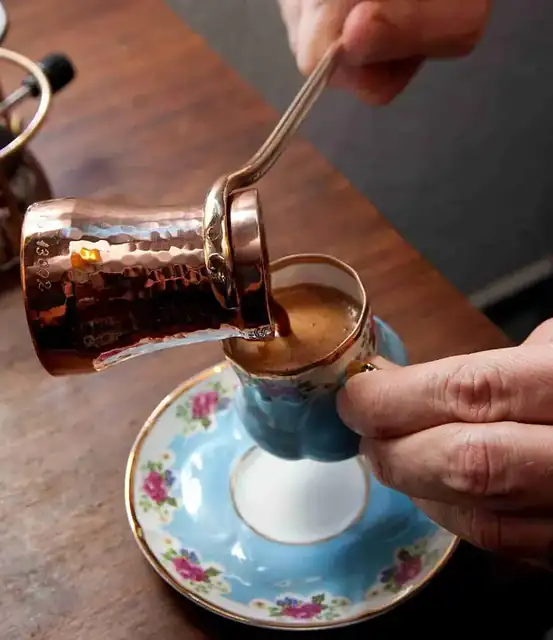
The dish is a starting point for exploring a wider food story. The guide below looks more closely at its background and different forms. When you want to cook, visit the recipe collection for ingredient quantities and step-by-step methods.
In this story
OverviewPreparationAccording to connoisseursIllegality and acceptanceSand coffeeDibek CoffeeCilveli CoffeeOverview
Turkish coffee (Turkish: Türk kahvesi) is a style of coffee prepared in a pot called a cezve using very finely ground coffee beans without filtering. The drink appears under different names across the Middle East, the Balkans, and the Caucasus.
Preparation
Turkish coffee as a beverage is very finely ground coffee brewed in water by bringing just to the boil. Any coffee beans may be used—there are no preferred "Turkish coffee beans". Arabica varieties are considered best, but robusta or a blend is also used. The very fine grind extracts intensely, so that the degree of roast has a big impact; beans are best roasted medium or medium-dark; light and dark roasts do not give best results. The fine grind also means that the coffee grounds will go stale soon after grinding. The coffee grounds remain in the coffee when served.
The coffee may be ground at home in a manual grinder made for the very fine grind (electric home grinders are not suitable), ground to order by coffee merchants in most parts of the world, or bought ready-ground—but less fresh—from many shops.
Coffee and water, with added sugar if desired, is brought just to the boil in a special pot called cezve in Turkey, and often called ibrik elsewhere. As soon as the mixture begins to froth it is taken off the heat; sometimes a little of the coffee, with the desired froth, is then distributed among small cups holding about 90ml (traditionally porcelain cups called kahve fincanı, 'coffee cup'). The coffee is typically briefly brought to the boil twice more to increase the desired froth, and is then served.
According to connoisseurs
In a paper for the 2013 Oxford Food Symposium, Tan and Bursa identified the features of the art or craft of making and serving Turkish coffee in the traditional way:
Roasting. Green coffee beans, ideally the best Arabica beans, are medium-roasted in small quantities over steady heat in a shallow, wrought-iron roasting pan. It is crucial to stop at the right moment, then transfer the beans to the next stage:
Cooling. The beans are allowed to cool and absorb excess oil in a wooden box. The kind of wood is claimed to affect the taste, walnut being the best.
Illegality and acceptance
The English word coffee derives from Turkish kahve, which came from Arabic qahwah, which could mean . It is sometimes stated that coffee was forbidden in Islam, albeit the ban was not very effective. However, it seems that most Muslim religious scholars were not averse to coffee, or actively supported it; but governments wanted to suppress coffee gatherings, fearing they were foci of political dissent. "What was condemned was not caffeine's physiological effects but rather the freedom of coffeehouse talk which rulers considered subversive".
Already in 1543 several ships were ordered to be sunk in Istanbul harbour for importing coffee. Under Sultan Murad IV those found keeping a coffeehouse were cudgelled for a first offence, and sewn in a bag and thrown into the Bosphorus for a second. These bans were sporadic and often ignored. (Similarly, the government of Charles II of England tried to suppress coffee houses as seditious gatherings—the ban lasted a few days—and, much later, the republican government of Mustafa Kemal Atatürk tried to prohibit or discourage coffeehouses in Turkish villages, saying they were places where men gathered to waste their time). Eventually the authorities found it to their advantage to tax rather than suppress the trade. Fifteen years after coffee arrived in Istanbul there were over 600 coffeehouses according to an Armenian historian.
It was not easy to prepare Turkish coffee very well at the time, and prominent Ottoman Turks kept specialist coffee cooks for the purpose. Suleiman the Magnificent had a kahvecibasi or chief coffee-cook, and it became a traditional practice for sultans. To demonstrate the civility of their rule, they built magnificent coffeehouses in newly conquered parts of the Ottoman Empire.
Sand coffee
An ancient traditional method involves placing the cezve filled with coffee in a pan filled with hot sand. The pan is heated over an open flame, thereby letting the sand take total control of the heat. The heat created by the sand lets the coffee foam to the top almost immediately. The heat can also be adjusted by the depth of the cezve in the sand. This process is usually repeated three to four times, and the coffee is then served in small cups.
Dibek Coffee
Dibek Coffee is a type of Turkish coffee named after the traditional method used to grind the beans. Originally, “dibek” referred to two slightly indented stones used to crush roasted coffee beans by rubbing them together. Over time, the design of the dibek became deeper and more practical.
The roasted beans are crushed in the dibek using a wooden or iron hammer until they reach the desired size. Unlike finely powdered coffee, the coffee ground in a dibek has a coarse texture. This method preserves the aromatic oils in the coffee, enhancing its flavor and helping to maintain its foam during cooking.
Dibek Coffee is recognized as a local specialty in various regions of Turkey. A coffeehouse in Kırklareli that serves dibek coffee has been operating since 1877. It is considered a local product in the Gökçeada district of Çanakkale and Zeytinliköy. Dibek Coffee is highlighted as a gastronomic representative of İzmir and its surrounding areas, including Urla, Seferihisar, Sığacık, Çeşme, Alaçatı, and nearby villages.
Cilveli Coffee
Cilveli Coffee is made by adding a mixture of double-roasted ground almonds and two spices to foamy Turkish coffee in a cup. A spoon is served alongside the coffee, allowing the guest to first eat the almond mixture on top before drinking the coffee. The combination of the almond mixture and foam creates a unique flavor. Double-roasting the almonds prevents them from sinking to the bottom of the coffee.
Cilveli Coffee is a traditional type of Turkish coffee from Manisa. Historically, it was prepared for princes, and in Manisa, it is also part of marriage rituals. Young women would offer this coffee to show their approval of a suitor and his family during a visit.
More to savor

Algerian Mint Tea

Caramel Squares
Matcha: The Japanese Tea You Drink as a Powder