A drink can be an everyday routine, something shared with company, or a way to explore a food tradition. The background below looks more closely at the preparation and story behind the cup or glass.
In this story
OverviewPowdered and compressed teasDeclining usage of compressed teaTraditionsCharacteristicsProductionPreparationOverview
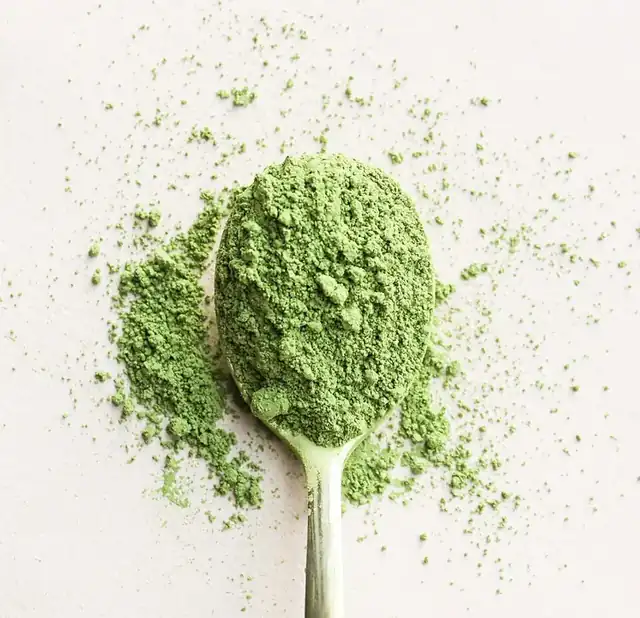
Matcha (Japanese: 抹茶) is a finely ground powder of green tea specially processed from shade-grown tea leaves. Shade growing gives matcha its characteristic bright green color and strong umami flavor. Matcha is typically consumed suspended in hot water.
Matcha originated through cultural exchanges between China and Japan in the premodern period, developing from earlier powdered tea practices in China that were transmitted to Japan by Zen Buddhist monks. During the Song dynasty, tea leaves were ground into a fine powder and whisked with hot water. This method was introduced to Japan by the monk Eisai around 1191, where it continued to develop and ultimately evolved into what the world knows today as matcha even as such practices declined in China.
Powdered and compressed teas
Powdered tea originated in China during the Tang dynasty (618–907) where tea leaves were pounded and then milled into fine powder before being shaped into "cakes". The Classic of Tea, written by Chinese tea master Lu Yu roughly between 760 to 762 CE, had documented the practise of steeping powdered tea in hot water. This involved first roasting compressed tea over a fire and then grinding it in a wooden grinder called a niǎn (碾, Japanese: yagen), boiling water in a pot, adding salt once it comes to a boil, then adding the tea powder to the boiling water and boiling it until it began to foam. The tea was also sometimes mixed with green onions, ginger, jujubes, mandarin orange peels, Tetradium ruticarpum, and mint.
It wasn't until the Song dynasty (960–1279) when whisks, bowls, and other tools first appeared in China that was used to froth up a drink called "mo cha", which translates to "powdered tea", and was made from steamed and dried tea leaves. According to Katharine P. Burnett, a tea scholar at the University of California, Davis, it was also during this era when Zen Buddhist monks from Japan began to visit China to attain books and sutras from Chinese scholars, and Japanese Buddhist monks will often encounter mo cha and its style of preparation in the Chinese temples. The beverage was prepared by whipping the tea powder with hot water in a bowl.
Although the term "matcha" (抹茶) was not yet used, the practice of preparing powdered tea with a tea whisk is believed to have originated in China no later than the 11th century.
Declining usage of compressed tea
The complex manufacturing process of lump tea during the Song dynasty required significant labor and expense, and even the slightest error could result in failure. As a result, it was costly and inaccessible to the common people. During the Tang dynasty, "bitter when sipped and sweet when swallowed" (The Classic of Tea) was regarded as the ideal taste of tea. However, in the Song dynasty, this ideal was deliberately replaced with four desirable qualities: "aroma, sweetness, richness, and smoothness" (Treatise on Tea). This shift represented an attempt to eliminate the natural bitterness of tea. As a result, lump tea became an expensive and complicated product, and some scholars suggest this contributed to its rapid decline after the Ming dynasty.
In the Ming dynasty, the founding emperor Zhu Yuanzhang issued a ban on the production of compressed tea in 1391. This decree led to the abandonment of compressed tea in China. Instead, a new method—similar to modern tea preparation—in which loose tea is steeped in hot water and extracted, became the mainstream practice.
In Shen Defu's Wanli ye huo bian ("Unofficial Gleanings of the Wanli Era", 萬厲野獲編), it is recorded:
Traditions
Since the Muromachi period, the term tea master referred to tea manufacturers and sellers. During the Edo period (1603–1867), it came to refer specifically to the official tea masters of Uji, Kyoto, whose status was guaranteed by the Tokugawa shogunate. Uji tea masters were divided into three ranks: gomotsu tea masters, ofukuro tea masters, and otōri tea masters. They were permitted to use their family names and carry swords like samurai. They dealt exclusively with the shogun, the imperial court, and feudal lords, and did not sell tea to commoners. Shaded cultivation of tea was permitted only for Uji tea masters, who held a monopoly on the production of high-grade matcha and gyokuro (premium sencha).
The oldest known brand of matcha is . "Grandmother" refers to Myōshūni (妙秀尼, d. 1598), daughter of Rokkaku Yoshikata, who married Kanbayashi Hisashige. She was affectionately called "Baba" by Tokugawa Ieyasu. Myōshūni was skilled in tea preparation, and Ieyasu often drank her tea. The matcha made using her method was named Baba Mukashi and was later served to the shogun. According to one theory, the name Baba Mukashi was bestowed by Ieyasu himself.
Other well-known brands included and , both of which were also presented to the shogun. and were also well-known.
Characteristics
The characteristics of matcha are as follows:
Color: bright green, might be dark green depending on which leaves are used
Flavor: strong umami flavor
Aroma: unique , like green laver
Production
The majority of matcha is produced in Japan, where it is highly regarded as part of the tea ceremony (chanoyu (茶の湯)) as well as used in sweets, baking, and confections. China and Vietnam also produce some matcha intended for export. This is a more recent modern development, and their production methods may differ significantly from the traditional Japanese method.
In Japanese production, the leaves of tencha are steamed and dried to prevent any further oxidation. It is usually steamed at 100 C for 10–15 seconds. The steaming softens the tea leaves and deactivates the oxidizing enzymes. The leaves are then dried in a tea processing machine and spread on a conveyor belt. The temperature inside the machine is set to approximately 170–200°C (338–392 °F) in the drying process, but the temperature of the tea leaves themselves is around 70°C. This leads to the suppression of glycosides.
Preparation
Matcha is typically consumed by mixing with hot water. There are two kinds of matcha tea – 濃茶 and 薄茶. Koicha is made by higher-grade matcha and less hot water with a lower temperature than for usucha. Usucha is foamed to reduce astringency while koicha is not foamed. Specifically, koicha is made from 4 g matcha and 30 ml of hot water at 80 C, and usucha is made with half matcha in twice the volume of hot water at 90 C. Due to the above differences, koicha has more of an original taste of matcha than usucha.
More to savor
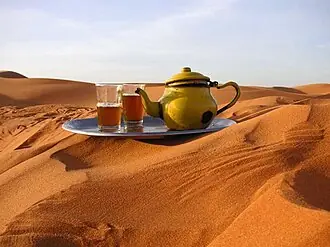
Algerian Mint Tea
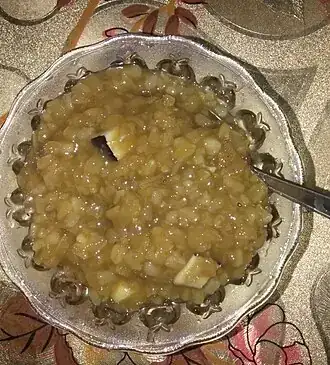
Sylheti Rice Pudding
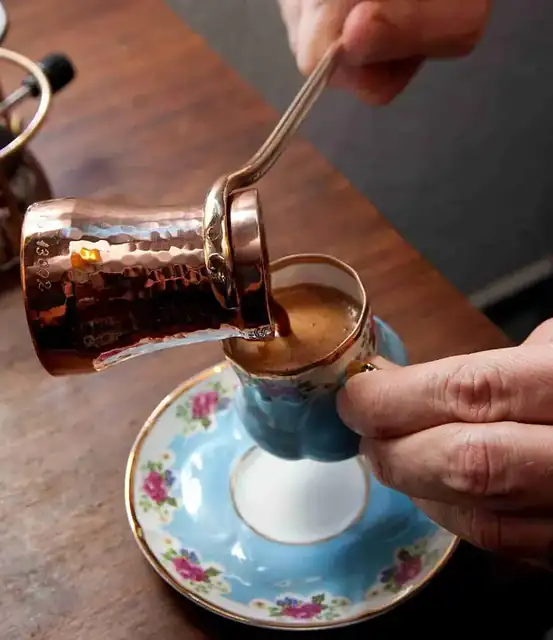
Turkish Coffee: A Small Pot and a Rich Serving Tradition