Use the regional background below as a starting point for exploring the food, rather than expecting one dish to represent every household. Food traditions differ within a country and continue to change through travel, migration, and everyday cooking.
In this story
OverviewEarly modern Ukrainian cuisineDishes of the cultural heritage of UkraineGalician cuisineLviv cuisineCarpathian cuisinesPodolian and Volhynian cuisinesOverview
Ukrainian cuisine is the collection of the various cooking traditions of the people of Ukraine, one of the largest and most populous European countries. It is heavily influenced by the rich dark soil (chornozem) from which its ingredients come, and often involves many components. Traditional Ukrainian dishes often experience a complex heating process – "at first they are fried or boiled, and then stewed or baked. This is the most distinctive feature of Ukrainian cuisine".
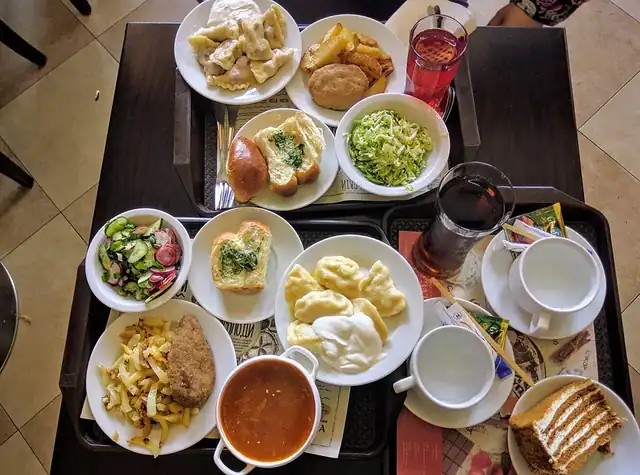
The national dish of Ukraine is red borscht, a well-known beet soup, of which many varieties exist. However, varenyky (boiled dumplings similar to pierogi) and a type of cabbage roll known as holubtsi are also national favourites, and are a common meal in traditional Ukrainian restaurants. These dishes indicate the regional similarities within Eastern European cuisine.
The cuisine emphasizes the importance of wheat in particular, and grain in general, as the country is often referred to as the "breadbasket of Europe". The majority of Ukrainian dishes descend from ancient peasant dishes based on plentiful grain resources such as rye, as well as staple vegetables such as potato, cabbages, mushrooms and beetroots. Ukrainian dishes incorporate both traditional Slavic techniques as well as other European techniques, a byproduct of years of foreign jurisdiction and influence. As there has been a significant Ukrainian diaspora over several centuries (for example, over a million Canadians have Ukrainian heritage), the cuisine is represented in European countries and those further afield, particularly Argentina, Brazil, and the United States.
Early modern Ukrainian cuisine
According to Ukrainian historian Oleksii Sokyrko, during the era of Polish–Lithuanian rule in the late medieval and early modern times the Ukrainian culinary tradition was developing as part of the general food culture of the Polish–Lithuanian Commonwealth. In that period cereals and bread continued to form the base of the diet for most people in Ukraine, but legumes including peas and beans were also widely consumed, particularly in western regions such as Galicia. One of the first documented mentions of borshch, the symbol of modern Ukrainian cuisine, also comes from the times of Polish rule: travelling through Kyiv in 1584, Danzig merchant Martin Gruneweg mentioned the widespread consumption of borshch by the local population; according to him, the dish was cooked in almost every household and consumed daily as both food and drink.
Another early mention of borshch in Ukrainian lands comes from Orthodox polemicist Ivan Vyshenskyi from Galicia, who described the dish as a typical peasant food. In the 18th century, after the incorporation of parts of Ukraine into the Russian Empire, borshch became popular at the imperial court in Saint Petersburg. It was also mentioned in Ivan Kotliarevsky's Eneida, the pioneering work of modern Ukrainian literature, on par with halushky, another popular traditional Ukrainian dish.
Dishes of the cultural heritage of Ukraine
The National Register of Elements of Cultural Heritage of Ukraine includes the following Ukrainian dishes:
Avdiivka kasha – sweet rice porridge cooked with milk, eggs, and butter from Avdiivka;
Borscht – sour soup usually cooked with beetroots;
Buzynnyk – dessert made from elderberries;
Çiberek and yantıq – Crimean Tatar fried turnovers with minced meat;
Christmas prianyky from Slobozhanshchyna – decorated gingerbread cookies;
Et ayaklak – Crimean Karaite pie with meat;
Holubtsi – cabbage rolls;
Hutsul bryndzya – Hutsul sheep cheese;
Lekvar – Transcarpathian sugar-free plum jam;
Milina – Bessarabian cheese pie;
Galician cuisine
Culinary experts recognize the existence of a distinct Galician cuisine, which has its roots in the territory between the Carpathian Mountains in the west and Ternopil region in the east. Galician cuisine formed on the base of numerous subethnic groups inhabiting the region, such as Hutsuls, Boykos and Lemkos. Yuriy Vynnychuk considers rural and urban Galician cuisines to be separate phenomena. Taras Voznyak classifies Galician cuisine as part of a broader Central European cuisine. A distinct feature of Galician culinary traditions is the presence of significant Austrian, Italian and Hungarian influences as a result of the territory spending part of its history under Austrian rule. Galician cuisine also influenced the traditions of Polish cuisine. An important source on the history of Galician cuisine is Practical Kitchen by Olha Franko.
Among typical Galician dishes are zhur, knishes, machanka (a thick meat soup of Lemko origin), cabbage, white borshch, banosh, Yavoriv pie, holubtsi, spelt bread, knedle and maslianka. A popular dish of Ternopil Oblast is millet kulesha with cracklings. Popular desserts of Galicia include strudel and cheesecake. An original recipe from Ivano-Frankivsk Oblast are hombovtsi - filled dumplings similar to pierogi leniwe or baozi.
Lviv cuisine
The city of Lviv developed its own culinary tradition, which influenced the cuisines of both Poland and Ukraine. Among its signature dishes are pierogi with potatoes, cheese and onions; veal broth with beans and noodles; chicken broth with farina; kluski made of farina, eggs and greens; yabchanka with cloves; various fruit and berry soups; nut cake. Typical breakfast foods consumed in Lviv are milk coffee, bread and butter, cottage cheese with sour cream. An important part in the diet of Leopolitans has traditionally been played by buckwheat kasha and maize porridge (mamaliga). Among meat dishes historically widespread in Lviv are pork schnitzel, zrazy, roast beef and fried chicken. A traditional Lviv dessert is legumina, washed down with kompot. During the summer period, Leopolitans would also consume many vegetables.
A traditional variety of Lviv kutia is prepared with boiled wheat grains, raisins, poppy seed, honey and lemon juice. Historically, Lviv has also been an important centre of beer and wine production.
Carpathian cuisines
Traditional dishes of the Boykos include knishes, oshchypky (unleavened bread), mushroom soup, battered peas, machanka and "black pies".
The most important ingredients of Hutsul cuisine are maize, potatoes, beans, mushrooms and bryndza. Traditional Hutsul dishes include banosh (maize flour porridge), huslianka (sour milk), vurda (sheep milk cheese), budz, pancakes and shupenia (a dish made from beans).
Podolian and Volhynian cuisines
Vinnytsia Oblast in the historical region of Podolia is known for the popularity of dishes from Polish cuisine, such as bigos and flaki, which are also widespread in nearby Galicia. In Khmelnytsky Oblast various sausages are popular, including vederey - pork intestine filled with potato. A traditional speciality of the village of Ulaniv are potatoes fried in oil with onion, garlic and other spices.
The region of Volhynia is known for dishes such as mazuryky - turkey sausages filled with butter and cheese. Other popular local dishes are verhuny and zrazy.
More to savor
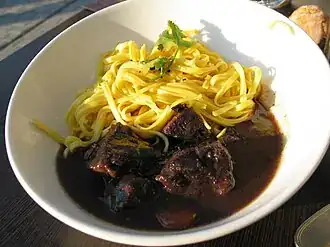
Boeuf Bourguignon
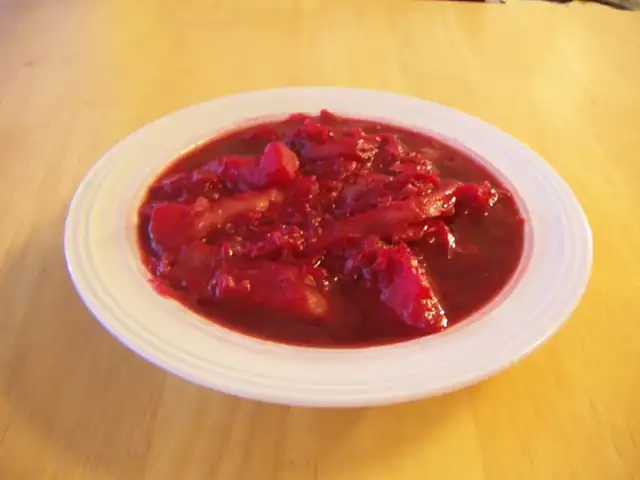
Borscht
At the English Table: Everyday Food and Familiar Traditions