The dish is a starting point for exploring a wider food story. The guide below looks more closely at its background and different forms. When you want to cook, visit the recipe collection for ingredient quantities and step-by-step methods.
In this story
OverviewPersian, Chinese, and Roman cuisinesEarliest written documentationEuropeFranceIngredients and legal definitionsOverviewOverview
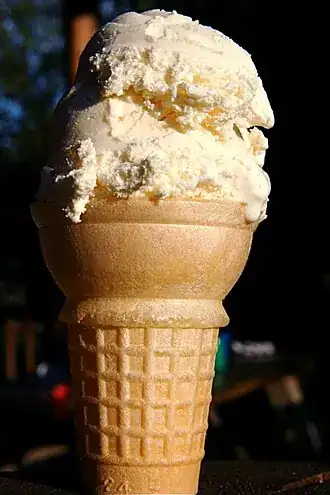
Ice cream is a frozen dessert typically made from milk or cream that has been flavoured with a sweetener, either sugar or an alternative, and a spice, such as cocoa or vanilla, or with fruit, such as strawberries or peaches. Food colouring is sometimes added in addition to stabilizers. The mixture is cooled below the freezing point of water and stirred to incorporate air spaces and prevent detectable ice crystals from forming. It can also be made by whisking a flavoured cream base and liquid nitrogen together. The result is a smooth, semi-solid foam that is solid at very low temperatures (below 35 F). It becomes more malleable as its temperature increases.
Ice cream may be served in dishes, eaten with a spoon, or licked from edible wafer hand-held ice cream cones as finger food. Ice cream may be served with other desserts such as cake or pie, used as an ingredient in cold dishes such as ice cream floats, sundaes, milkshakes, and ice cream cakes, or in baked items such as Baked Alaska. It is often sold in dedicated ice cream parlors, carts, stands or vans.
The Italian word for ice cream, gelato ("frozen"), is often used in English. Frozen custard is a type of rich ice cream. Soft serve is softer and is often served at amusement parks and fast-food restaurants in the United States. Ice creams made from cow's milk alternatives, such as goat's or sheep's milk, or milk substitutes (e.g., soy, oat, cashew, coconut, almond milk, or tofu), are available for those who are lactose intolerant, allergic to dairy protein, or vegan. Banana "nice cream" is a 100% fruit-based vegan alternative. Frozen yoghurt, or "froyo", is similar to ice cream but uses yoghurt, and is usually lower in fat. Fruity sorbets or sherbets without dairy content are usually also sold in ice cream shops.
Persian, Chinese, and Roman cuisines
The origins of frozen desserts are obscure, although several accounts exist about their history. According to some sources, the history of ice cream begins in ancient Persia around 550 BC and Persian engineering techniques for storing and using ice led to the creation of the forerunner of all frozen desserts.
A Roman cookbook dating back to the 1st century includes recipes for sweet desserts sprinkled with snow, and there are Persian records from the 2nd century for sweetened drinks chilled with ice.
Earliest written documentation
The earliest known written process to artificially make ice is known not from culinary texts, but the 13th-century writings of Syrian historian Ibn Abi Usaybi'a in his book "Kitab Uyun al-anba fi tabaqat-al-atibba" (Book of Sources of Information on the Classes of Physicians) concerning medicine in which Ibn Abi Usaybi'a attributes the process to an even older author, Ibn Bakhtawayhi, of whom nothing is known.
Ice cream production became easier with the discovery of the endothermic effect. Prior to this, cream could be chilled easily but not frozen. The addition of salt lowered the melting point of ice, drawing heat from the cream and allowing it to freeze.
Europe
The technique of freezing was not known from any European sources prior to the 16th century. During the 16th century, authors made reference to the refrigerant effect that happened when salt was added to ice. By the latter part of the 17th century sorbets and ice creams were made using this process.
Ice cream's spread throughout Europe is sometimes attributed to Moorish traders, but more often Marco Polo. Though it is not mentioned in any of his writings, Polo is often credited with introducing sorbet-style desserts to Italy after learning of them during his travels to China. According to a legend, the Italian duchess Catherine de' Medici introduced flavoured sorbet ices to France when she brought Italian chefs with her to France upon marrying the Duke of Orléans (Henry II of France) in 1533. However, no Italian chefs were present in France during the Medici period, and ice cream already existed in France before de Medici was born.
France
In 1665, the Catalogue des Marchandises rares..., edited in Montpellier by Jean Fargeon, listed a type of frozen sorbet. While the composition of this sorbet is not provided, Fargeon specified that it was consumed frozen using a container that was plunged into a mixture of ice and saltpetre. These sorbets were transported in pots made of clay and sold for three livres per pound.
According to L'Isle des Hermaphrodites, the practice of cooling drinks with ice and snow had already emerged in Paris, particularly in the court, during the 16th century. The narrator notes that his hosts stored ice and snow, which they later added to their wine. This practice slowly progressed during the reign of Louis XIII and was likely a necessary step towards the creation of ice cream. In 1682, Le Nouveau confiturier françois provided a recipe for a specific type of ice cream, called "neige de fleur d'orange".
Ingredients and legal definitions
Many countries have regulations controlling what can be described as ice cream.
In the United Kingdom, Food Labelling Regulations (1996) set a requirement of at least 5% milk fat and 2.5% milk protein in order to be sold as ice cream within the UK. In rest of the European Union, a trade organization called European Ice Cream Association calls for minimum dairy fat content of 5%. In 2015, these regulations were relaxed so that containing milk fat or protein was no longer necessary in the UK for a product to be sold as "ice cream", though at least 5% milk fat is still required for a product to be labeled "dairy ice cream". After this change, many UK products labelled as "ice cream" substitute milk fat with cheaper alternatives like palm oil, coconut oil, and vegetable fats.
In the US, the FDA rules state that to be described as "ice cream", a product must have the following composition:
greater than 10% milk fat
Overview
Italian ice cream, also known as gelato, is a traditional and popular dessert in Italy. Much of the production is still hand-made and flavoured by each individual shop in gelaterie a produzione propria. Gelato is made from whole milk, sugar, sometimes eggs, and natural flavourings. It typically contains 4–9% fat, less than ice cream's minimum of 10%.
Per capita, Australians and New Zealanders are among the leading ice cream consumers in the world, eating 18 L and 20 L each per year respectively, behind the United States where people eat 23 L each per year.
More to savor

Fried Bananas
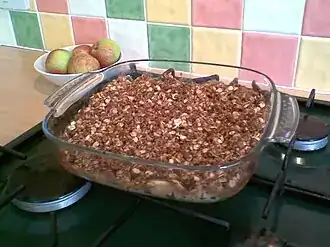
Apple Crisp I
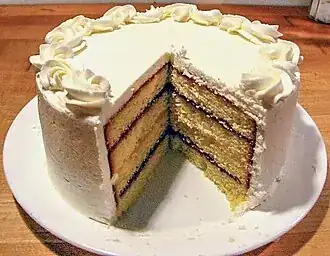
Cake: A Slice of Celebration, a World of Possibilities