Use the regional background below as a starting point for exploring the food, rather than expecting one dish to represent every household. Food traditions differ within a country and continue to change through travel, migration, and everyday cooking.
In this story
OverviewCultural and regional influencesStructure of mealsFood establishmentsMalay cuisineJavanese-influenced cuisineMalaysian Chinese cuisineOverview
Malaysian cuisine (Malay: Masakan Malaysia) consists of cooking traditions and practices found in Malaysia, and reflects the multi-ethnic makeup of its population. The vast majority of Malaysia's population can roughly be divided among three major ethnic groups: Malays, Chinese and Indians. The remainder consists of the indigenous peoples of Sabah and Sarawak in East Malaysia, the Orang Asli of Peninsular Malaysia, the Peranakan and Eurasian creole communities, as well as a significant number of foreign workers and expatriates.
As a result of historical migrations, colonisation by foreign powers, and its geographical position within its wider home region, Malaysia's culinary style in the present day is primarily a melange of traditions from its Malay, Chinese, Indian, Indonesian, Thai, Filipino and indigenous Bornean and Orang Asli, with light to heavy influences from Arab, Thai, Portuguese, Dutch and British cuisines, among others.
Cultural and regional influences
Being a multicultural country, Malaysians have over the years adopted each other's dishes to suit the taste buds of their own culture. For instance, Malaysians of Chinese descent have adapted the Indian curry, and made it more dilute and less spicy to suit their taste. Chinese noodles have been crossed with Indian and Malay tastes and thus Malay fried noodles and Indian fried noodles were born. Malaysians have also adapted famous dishes from neighbouring countries, or those with strong cultural and religious ties, and in the absence of an established community from said countries have made it completely their own, a notable example being tom yam, one of Thailand's most well-known dishes
After migrating south of the border, Thai tom yam adopts the visual characteristics of a Malaysian Assam gravy, with a flavor profile that is sweet, sour, and spicy. It is thickened with pounded chili paste, which also gives it a vivid orange-red color. Tamarind is often used instead of lime juice as the souring agent, and dried chilies, rather than fresh ones, are used to provide a fiery kick. Malay-style tom yam soup tends to be heavily seafood-based, whereas in Chinese-style eateries, the broth's spiciness is toned down and it is usually served as a base for noodle soup.
Structure of meals
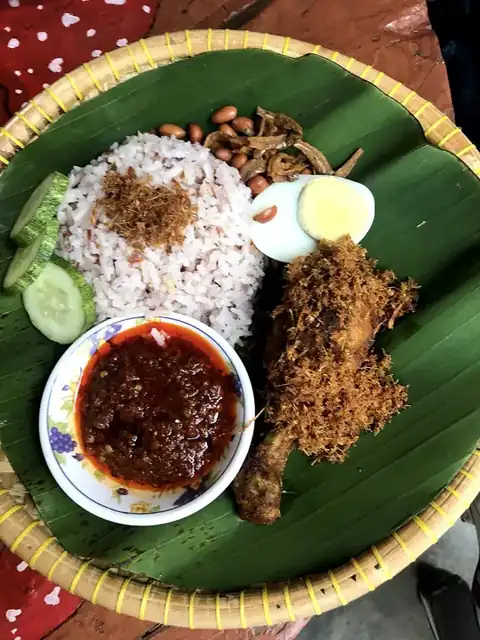
There is no standard breakfast (sarapan) menu due to Malaysia's multi-ethnic social fabric as well as the advent of modern influences. Western-style breakfast like breakfast cereal, cooked eggs and toast have become commonplace in homes and when dining out, but heartier traditional fare based predominantly on noodles and rice dishes are still very popular. One may choose to start the day with the ubiquitous nasi lemak or kuih; venture for Chinese-style congee, dim sum and noodle soups; or settle for Indian-influenced fare such as roti canai, idli (இட்லி iṭli ), thosai (தோசை tōcai ), and upma. In the state of Kelantan, the term nasi berlauk refers to a breakfast meal which consists of a small serve of rice and complementary dishes or lauk.
For lunch and dinner, food is not customarily served in courses but rather concurrently. A meal may consist of a single dish for solitary diners, or rice with many complementary dishes shared by all. At restaurants where food is cooked to order, there is often no distinction between appetizers/starters and main courses, and food will arrive at the table whenever it is ready. At some traditionally-run eateries where pre-cooked food is served, diners are meant to help themselves by starting with a plate of plain rice and choose from a buffet spread of assorted dishes. Like the Indonesian Nasi Padang, this is not an all-you-can-eat for a fixed price dining experience.
Food establishments
A kopitiam or kopi tiam is a traditional coffee shop patronised for meals and beverages, predominantly operated by Chinese proprietors and especially members of the Hainanese community. The word kopi is a Malay/Hokkien term for coffee and tiam is the Hokkien and Hakka term for shop (Chinese : 店). A common sight in Malaysia and neighbouring Singapore, menus often feature offerings like nasi lemak, boiled eggs, roti bakar, noodle dishes, bread and kuih. The owners of some kopitiam establishments may lease premise space to independent stallholders, who sometimes offer more specialised dishes beyond standard Chinese kopitiam fare. Typical beverages include Milo, a malted chocolate drink considered iconic to Malaysians of all ages, as well as coffee (kopi) and tea (teh).
Malay cuisine
For a traditional Malay meal, rice is considered the centerpiece of a meal, with everything else considered as an accompaniment, relish or side dish for the rice. Malay cuisine bears many similarities to Indonesian cuisine, in particular some of the regional traditions from Sumatra. It has also been influenced by Chinese, Indian, Thai and many other cultures throughout history, producing a distinct cuisine of their own. Some regional Malay dishes, such as arisa and kacang pool, are examples of influence from Arab cuisine due to longstanding historical and religious ties. Many Malay dishes revolve around a rempah, which is usually sauteed in oil (tumis) to draw out flavours to form the base of a dish. A dipping relish called sambal is an essential accompaniment for most Malay dishes.
Javanese-influenced cuisine
There are certain Malaysian dishes with overt Javanese influences or are direct adaptations from Javanese cuisine, brought to Malaysia by Javanese immigrants who have been assimilated or integrated into the wider Malay community to various degrees. Javanese cuisine is highly distinct from mainstream Malay cooking, being noted for its simplicity and sweeter flavours, as opposed to mainstream Malay cuisine which is predominantly based on the complex and spicy regional cuisines of Sumatra. A popular way of serving Javanese-influenced food in the southern part of Peninsular Malaysia is termed nasi ambang, which consists of shared platters of white rice served with accompaniments like chicken cooked in soy sauce or curried gravy, stir-fried noodles, sambal goreng, fried shredded coconut pieces, egg, vegetables and so on.
Malaysian Chinese cuisine
Malaysian Chinese cuisine is derived from the culinary traditions of Chinese Malaysian immigrants and their descendants, who have adapted or modified their culinary traditions under the influence of Malaysian culture as well as immigration patterns of Chinese to Malaysia. Because the vast majority of Chinese Malaysians are descendants of immigrants from southern China, Malaysian Chinese cuisine is predominantly based on an eclectic repertoire of dishes with roots from Cantonese cuisine, Hakka cuisine, Fujian cuisine and Teochew cuisine.
More to savor

Chicken Vindaloo

Sylheti Onion and Rice Fritters
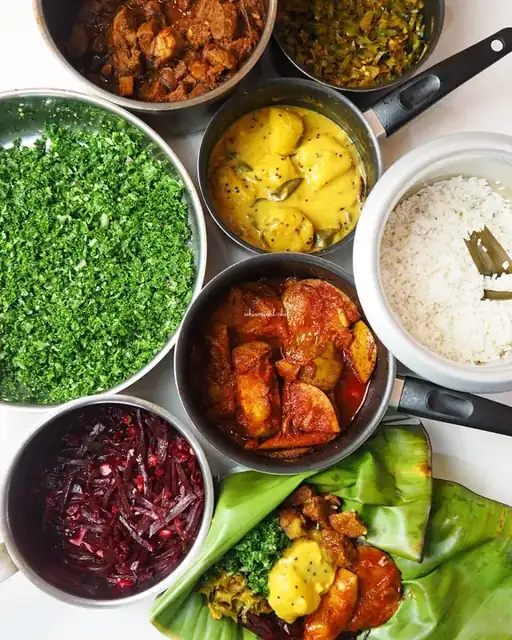
A Taste of Sri Lanka: The Combinations Behind the Flavor