This longer reference provides the background behind the topic. Read it alongside the recipe collection when you want to connect an ingredient or food idea with a dish to prepare.
In this story
OverviewProductionFood securityWorldwide consumptionEating qualitiesGreenhouse gases from rice productionEffects of climate change on rice productionOverview
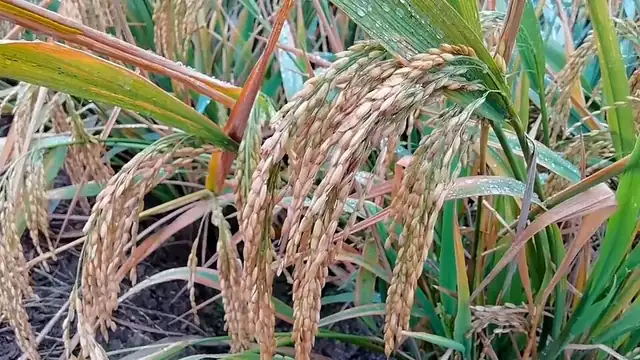
Rice is a cereal grain and, in its domesticated form, is the staple food of over half of the world's population, particularly in Africa and Asia. Rice is the seed of the grass species Oryza sativa (Asian rice)—or, less commonly, Oryza glaberrima (African rice). Asian rice was domesticated in China some 13,500 to 8,200 years ago; African rice was domesticated independently in West Africa about 3,000 years ago. Rice has become commonplace in many cultures worldwide; in 2023, 800 million tons were produced, placing it third after sugarcane and maize. Cooked white rice contains 29% carbohydrate and 2% protein, with some manganese. Golden rice is a variety produced by genetic engineering to contain vitamin A.
Production of rice is estimated to have caused over 1% of global greenhouse gas emissions in 2022. Predictions of how rice yields will be affected by climate change vary across geographies and socioeconomic contexts. In human culture, rice plays a role in various religions and traditions, such as in weddings.
Production
In 2023, world production of rice was 800 million tonnes, led by China and India with a combined 52% of the total. This placed rice third in the list of crops by production, after sugarcane and maize. Other major producers were Bangladesh, Indonesia and Vietnam. 90% of world production is from Asia.
Food security
Rice is a major food staple in Asia, Latin America, and some parts of Africa, feeding over half the world's population. However, a substantial part of the crop can be lost post-harvest through inefficient transportation, storage, and milling. A quarter of the crop in Nigeria is lost after harvest. Storage losses include damage by mould fungi if the rice is not dried sufficiently. In China, losses in modern metal silos were just 0.2%, compared to 7–13% when rice was stored by rural households.
Processing
The dry grain is milled to remove the outer layers, namely the husk and bran. These can be removed in a single step, in two steps, or as in commercial milling in a multi-step process of cleaning, dehusking, separation, polishing, grading, and weighing. Brown rice only has the inedible husk removed. Further milling removes bran and the germ to create successively whiter products. Parboiled rice is subjected to a steaming process before it is milled. This makes the grain harder, and moves some of the grain's vitamins and minerals into the white part of the rice so these are retained after milling.
Worldwide consumption
As of 2016, the countries that consumed the most rice were China (29% of total), India, and Indonesia. By 2020, Bangladesh had taken third place from Indonesia. On an annual average from 2020 to 2023, China consumed 154 million tonnes of rice, India consumed 109 million tonnes, and Bangladesh and Indonesia consumed about 36 million tonnes each. Across the world, rice consumption per capita fell in the 21st century as people in Asia and elsewhere ate less grain and more meat. An exception is Sub-Saharan Africa, where both per capita consumption of rice and population are increasing.
Eating qualities
Rice is a commonly-eaten food around the world. The varieties of rice are typically classified as short-, medium-, and long-grained. Oryza sativa indica varieties are usually long-grained; Oryza sativa japonica varieties are usually short- or medium-grained. Short-grain rice, with the exception of Spanish Bomba, is usually sticky when cooked, and is suitable for puddings. Thai Jasmine rice is aromatic, and unusually for a long-grain rice has some stickiness, with a soft texture. Indian Basmati rice is very long-grained and aromatic. Italian Arborio rice, used for risotto, is of medium length, oval, and quite sticky. Japanese sushi rice is a sticky short-grain variety.
Greenhouse gases from rice production
In 2022, greenhouse gas emissions from rice cultivation were estimated at 5.7 billion tonnes CO2eq, representing 1.2% of total emissions. Within the agriculture sector, rice produces almost half the greenhouse gas emissions from croplands, some 30% of agricultural methane emissions, and 11% of agricultural nitrous oxide emissions. Methane is released from rice fields subject to long-term flooding, as this inhibits the soil from absorbing atmospheric oxygen, resulting in anaerobic fermentation of organic matter in the soil. Emissions can be limited by planting new varieties, not flooding continuously, and removing straw.
It is possible to cut methane emissions in rice cultivation by improved water management, combining dry seeding and one drawdown, or executing a sequence of wetting and drying. This results in emission reductions of up to 90% compared to full flooding and even increased yields.
Effects of climate change on rice production
Predictions of climate change's effects on rice cultivation vary. Global rice yield has been projected to decrease by around 3.2% with each 1°C increase in global average temperature while another study predicts global rice cultivation will increase initially, plateauing at about 3°C warming (2091–2100 relative to 1850–1900).
The impacts of climate change on rice cultivation vary across geographic location and socioeconomic context. For example, rising temperatures and decreasing solar radiation during the later years of the 20th century decreased rice yield by between 10% and 20% across 200 farms in seven Asian countries. This may have been caused by increased night-time respiration. IRRI has predicted that Asian rice yields will fall by some 20% per 1°C rise in global mean temperature. Further, rice is unable to yield grain if the flowers experience a temperature of 35°C or more for over one hour, so the crop would be lost under these conditions.
In the Po Valley in Italy, the arborio and carnaroli risotto rice varieties have suffered poor harvests through drought in the 21st century. The Ente Nazionale Risi is developing drought-resistant varieties; its nuovo prometeo variety has deep roots that enable it to tolerate drought, but is not suitable for risotto.
More to savor

Chicken Vindaloo
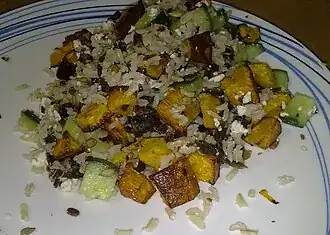
Roast Butternut, Biltong and Brown Rice Salad
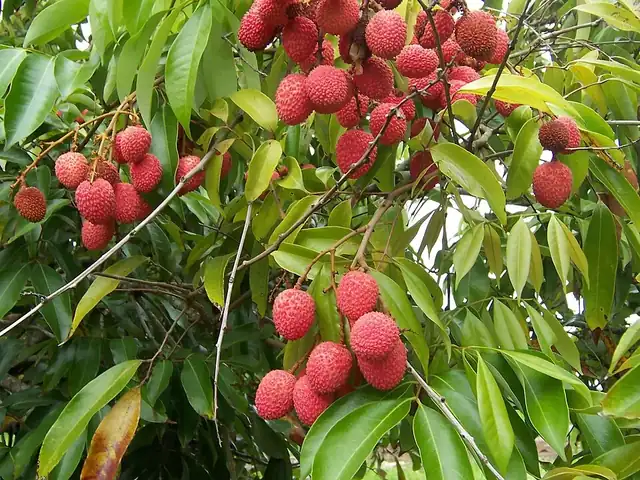
Lychee in the Kitchen: Exploring an Everyday Ingredient