
A drink can be an everyday routine, something shared with company, or a way to explore a food tradition. The background below looks more closely at the preparation and story behind the cup or glass.
Overview
Mead , also called honey wine, and hydromel (particularly when low in alcohol content), is an alcoholic beverage made by fermenting honey mixed with water, and sometimes with added ingredients such as fruits, spices, grains, or hops. The alcoholic content ranges from about 3.5% ABV to more than 20%. Possibly the most ancient alcoholic drink, the defining characteristic of mead is that the majority of the beverage's fermentable sugar is derived from honey. It may be still, carbonated, or naturally sparkling, and despite a common misconception that mead is exclusively sweet, it can also be dry or semi-sweet.
Mead that also contains spices is called ' , and mead that contains fruit is called melomel. The term honey wine''' is sometimes used as a synonym for mead, although wine is typically defined to be the product of fermented grapes or certain other fruits, and some cultures have honey wines that are distinct from mead. The honey wine of Hungary, for example, is the fermentation of honey-sweetened pomace of grapes or other fruits.
Mead was produced in ancient times throughout Europe, Africa, and Asia, and has played an important role in the mythology of some peoples, which sometimes ascribed magical or supernatural powers to it. In Norse mythology, for example, the Mead of Poetry, crafted from the blood of Kvasir, would turn anyone who drank it into a poet or scholar.
History
Mead was possibly discovered among the first humans 20,000–40,000 years ago prior to the advent of both agriculture and ceramic pottery in the Neolithic, due to the prevalence of naturally occurring fermentation and the distribution of eusocial honey-producing insects worldwide; as a result, it is hard to pinpoint the exact historical origin of mead given the possibility of multiple discovery or potential knowledge transfer between early humans prior to recorded history. With the eventual rise of ceramic pottery and increasing use of fermentation in food processing to preserve surplus agricultural crops, evidence of mead begins to show up in the archaeological record more clearly, with pottery vessels from northern China dating from at least 7000 BCE discovered containing chemical signatures consistent with the presence of honey, rice, and organic compounds associated with fermentation.
The earliest surviving written record of mead is possibly the soma mentioned in the hymns of the Rigveda, one of the sacred books of the historical Vedic religion and (later) Hinduism dated around 1700–1100 BCE. The Rigveda predates the Indo-Iranian separation, dated to roughly 2000 BCE, so this mention may originate from the Western Steppe or Eastern Europe. The Abri, a northern Illyrian subgroup of the Taulantii, were known to the ancient Greek writers for their technique of preparing mead from honey. During the Golden Age of ancient Greece, mead was said to be the preferred drink. Aristotle (384–322 BCE) discussed mead made in Illiria in his Meteorologica and elsewhere, while Pliny the Elder (23–79 CE) used the name melitites in his Naturalis Historia for a grape and honey wine (Pliny, Bk 4, Ch. 9, Sec. 11).
The Hispanic-Roman naturalist Lucius Columella gave a recipe for mead (mella or aqua mulsa, lit. 'honeyed water') in De re rustica, about 60 CE.
Resurgence
Mead is experiencing a massive global resurgence. Consumers are shifting toward unique, natural alternatives to traditional beer and wine, driven by the popularity of "session meads" (lower-alcohol, carbonated styles) and craft brewing innovations. In Hong Kong, it is one of the only alcoholic drinks that can be brewed using local ingredients – ‘we’re preserving a bit of Hong Kong culture,’ one maker says. In the Philippines, brands like La Mesa Mead are creating meads with tropical elements.
Fermentation process
Meads often ferment at the same temperatures as wine, and the yeast used in mead making is often identical to that used in wine making (particularly white wines).
By measuring the specific gravity of the mead before and throughout the fermentation process using a hydrometer or refractometer, mead makers can determine the proportion of alcohol by volume in the final product.
Varieties
Mead can have a wide range of flavors depending on the source of the honey, additives (also known as "adjuncts" or "gruit") including fruit and spices, the yeast employed during fermentation, and the aging procedure. Some producers have erroneously marketed white wine sweetened and flavored with honey after fermentation as mead, sometimes spelling it "meade." Some producers ferment a blend of honey and other sugars, such as white refined sugar, again, mislabeling the product as mead. This is closer in style to a hypocras. Blended varieties of mead may be known by the style represented; for instance, a mead made with cinnamon and apples may be referred to as either a cinnamon metheglin or an apple cyser.
A mead that also contains spices (such as cloves, cinnamon or nutmeg), or herbs (such as meadowsweet, hops, or even lavender or chamomile), is called a metheglin .
A mead that contains fruit (such as raspberry, blackberry or strawberry) is called a melomel, which was also used as a means of food preservation, keeping summer produce for the winter. A mead that is fermented with grape juice is called a pyment.
Regional variants
In Finland, a sweet mead called sima is connected with the Finnish vappu festival (although in modern practice, brown sugar is often used in place of honey ). During secondary fermentation, added-raisins augment the amount of sugar available to the yeast and indicate readiness for consumption, rising to the top of the bottle when sufficiently depleted. Sima is commonly served with both the pulp and rind of a lemon.
An Ethiopian mead variant tej (ጠጅ) is usually home-made and flavored with the powdered leaves and bark of gesho, a hop-like bittering agent which is a species of buckthorn. A sweeter, less-alcoholic version (honey-water) called berz, aged for a shorter time, is also made.
In Kenya, a mead variant called muratina is usually home-made which is used during a number of different important religious and social events.
Mead in Poland and Ireland has been part of culinary tradition for over a thousand years.
Mead variants
Acerglyn: A mead made with honey and maple syrup.
Bais: A native mead from the Mandaya and Manobo people of eastern Mindanao in the Philippines. It is made from honey and water fermented for at least five days to a month or more.
Balché: A native Mexican version of mead.
More to savor
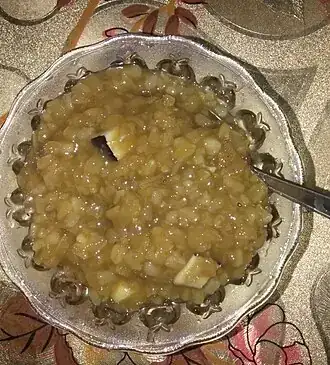
Sylheti Rice Pudding

Traditional Finnish Lemon Mead (Sima)

Wine: The Fermented Grape Drink with Many Regional Voices